














AI-Governed Labeling »
Fully Autonomous Alignment Systems
Data Annotation &
Labelling Platform
The Problem
AI progress constrained by human data labeling throughput
Core Bottlenecks:
- High Cost
- Extended Latency
- Complexity
- Quality Variance
- Preference Bias
The Agivant Solution
- AI-first annotation & labelling system
- Progressively removes humans from labeling loop
- Preserves quality, safety, and alignment
How Agivant Works
The shift from static cost centers to self-evolving assets.
01 - Bootstrap
02 - Learn
03 - Transition
04 - Autonomous
Enterprise Impact
60–85%
months » days
Iteration
cycles
Quality
Consistent,
bias-aware labels
Continuous
alignment & safety
tuning
The Paradigm Shift
From human-bound annotation to autonomous alignment systems
Shift Dimension
Current State
Future State
Reactive to Proactive
Moving from manual execution to strategic oversight.
- Humans manually label every sample
- Annotation is reactive
- Quality addressed downstream via rework
- AI-first annotation & labelling system
- Humans validate edge cases only
- Proactive routing of uncertain cases
Static to Continuous
From frozen datasets to living, breathing alignment.
- Dataset labeled once, then frozen
- Errors require re-annotation
- High cost and long cycles
- Continuous labeling loop
- AI identifies problematic labels
- Humans refine uncertain cases
Commodity to Expert
From mass labor to specialized judgment at scale.
- Annotation treated as low-skill work
- Interchangeable annotators
- Quality degradation
- Small expert teams handle
ambiguity - Experts define edge-case
policy - Judgment scales to billions
The Human Labeling Wall
Velocity Collapse
Quality Degradation at Scale
Operational Fragility
Non-Scalability by Design
Operating Model
Human Intelligence » Machine Judgment » Autonomous Alignment
Human Ground Truth Seeding
Labeling Intelligence Models
Semi-Autonomous Labeling
Fully Autonomous Labeling
“High-quality expert judgment that defines what ‘good’ looks like.”
- Small, high-quality expert datasets
- Preference judgments
- Safety evaluations
- Edge-case reasoning
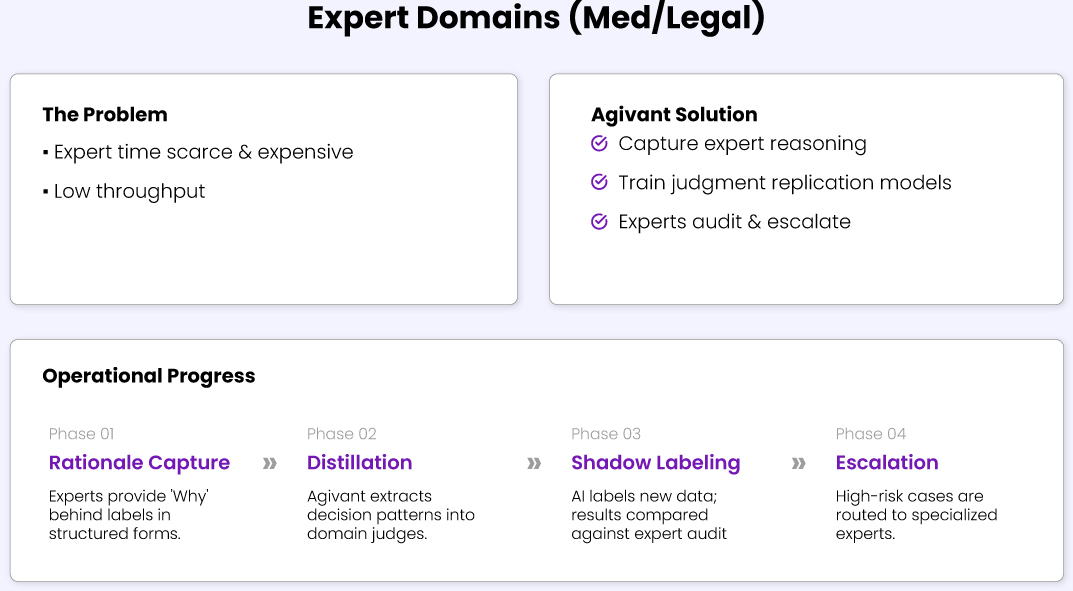
- Humans explain why, not just what
- Rationale behind labels is captured
“Creates a compact but information-dense ground truth dataset that defines correctness, bias boundaries, and alignment goals.”
“AI models that learn how humans judge, not how tasks are solved.
- Annotator decision patterns
- Consensus formation
- Bias correction
- Confidence estimation
- Separate pipelines per modality (text, images, multimodal)
- Task-specific confidence thresholds
- Validation rules tuned to complexity
Important Distinction
“These are judgment models, not task models.”
Outcome
“AI reliably labels the majority of data while knowing when it should not trust itself.”
“Human effort applied only where it has leverage.”
- Generates labels
- Assigns confidence scores
- Detects: High-uncertainty, Novel distributions, Safety-critical cases
- Review only ambiguous cases
- Focus on high-impact edge cases
- Handle safety-sensitive outputs
- Every correction analyzed
- Model retraining triggered
- Edge cases weighted heavily
“Continuous labeling governed by policy, not labor.”
- Labels data continuously
- Monitors confidence distributions
- Detects: High-uncertainty, Novel distributions, Safety-critical cases
- Perform statistical audits
- Define policies
- Update confidence thresholds
- Escalation rules
Continuous Feedback Loops
Annotation improvement loop Model training loop Preference & safety loop
“Annotation becomes always-on infra structure that improves over time instead of degrading.”
Strategic Success Stories
Enterprise Transformation Results
The Challenge
Scaling high-volume transcript labeling without degrading accuracy. Downstream ML models relied on precise datasets to extract critical business insights from massive customer interaction logs.
The Solution
Production-grade Golden Data Sets for training and validation.
Taxonomy Data Evaluation to standardize labeling logic.
Enterprise Memory Benchmarking for long-term consistency.
Key Objectives
Maintain consistent labeling across transcripts.
Scale to meet massive data volumes.
Support multiple downstream ML use cases.
Outcome
97% Labeling Accuracy
Reliable extraction of business intelligence from post-call datasets at an enterprise scale.
The Challenge
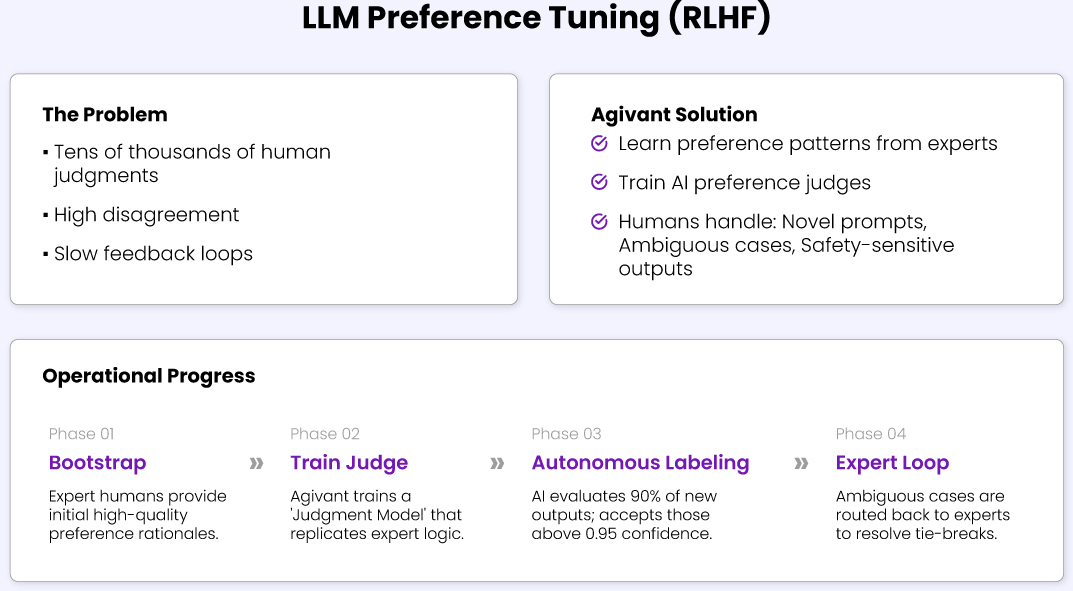
Rapid iteration of large AI models was constrained by slow, human-heavy data annotation pipelines. Each training cycle required tens of thousands of manual labels, delaying experiments, increasing costs, and limiting iteration velocity.
The Solution
AI-assisted labeling models trained on expert human judgments
Confidence-based automation to label the majority of data autonomously
Human review limited to ambiguous, novel, or high-impact samples
Key Objectives
Accelerate annotation throughput without scaling headcount
Reduce dependency on large human labeling teams
Enable faster model retraining and evaluation cycles
Outcome
65% REDUCTION IN MANUAL EFFORT
Annotation cycles reduced from weeks to days, enabling faster model iteration and improved time-to-market.
The Challenge
As AI-powered features expanded across products, manual annotation pipelines could not scale reliably. Labeling costs increased linearly with data volume, while quality drift slowed production releases.
The Solution
Autonomous data annotation pipelines with continuous confidence scoring
Human-in-the-loop governance focused on audits and edge cases
Progressive transition from human-led labeling to AI-governed labeling
Key Objectives
Scale annotation capacity without proportional human labor growth
Maintain consistent, high-quality labels across datasets
Accelerate deployment of AI-powered features
Outcome
2× FASTER ANNOTATION THROUGHPUT
Lower labeling costs, improved consistency, and faster AI product release cycles with reduced human dependency.